Trump’s crypto U-turn
Less than four years ago, Trump said Bitcoin “just seems like a scam”. Yet those reservations have now gone: the Trump family has since started the crypto firm World Liberty Financial, and Trump launched his own cryptocurrency, $TRUMP – 220 of its top buyers were invited to a private gala dinner with the president on Thursday.
 SOPA Images via Getty
Trump’s sons Eric and Donald Jr are behind a crypto mining venture called American Bitcoin, which plans to trade on the Nasdaq stock exchange, and aims to build one of the world’s largest and most efficient Bitcoin mining platforms, rooted in American soil.
Bitcoin mining has boomed in the US partly because of a crackdown in China in 2021, which was due to concerns over its environmental damage. Alexander Neumueller, an expert at the University of Cambridge’s Centre for Alternative Finance, says that although it’s hard to trace every last mine, it’s clear that the US is now the leading Bitcoin producer, mining about 40% of the world’s supply.
From village halls to state legal battles
Dresden is in New York’s Finger Lakes region – a rural area sliced through with deep glacial lakes, which attracts tourists drawn by its wineries, breweries and outdoor pursuits. In Yates County, home to Dresden and the Greenidge plant, around 60% of voters picked Trump last November.
According to the owners of the mine, Greenidge Generation, anywhere from 40 to 120 Bitcoin a month are being produced at the plant, along with some energy that flows back to the grid.
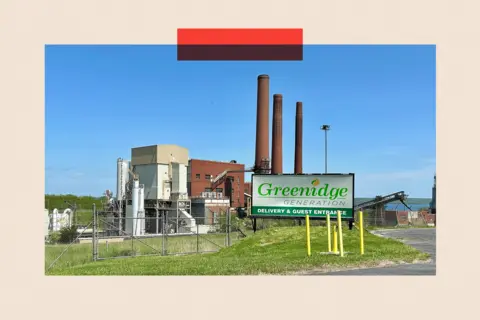
The company – which turned down requests for an interview – has argued that they converted a coal-burning operation into a relatively cleaner gas-fired power installation that complies with state environmental laws.
But amid public concern, New York state and Greenidge are currently engaged in a protracted legal battle over the plant’s future. With some of the strictest environmental laws in the country, New York officials are challenging whether the gas-fired plant is permitted under the regulations that allowed the old coal plant. Power generation – and Bitcoin mining – has been allowed to continue during appeal proceedings.
Abi Buddington, who owns a house in Dresden and has been at the forefront of the fight against the crypto mine, says it has become a big issue locally.
“The climate changed, both environmentally as well as in our quiet little community,” she says, recalling raised voices at contentious town hall meetings.

Ms Buddington is trying to change minds in Dresden and, through her network, elsewhere around the country.
“There are some who are environmentally concerned, and who may be Republican-leaning,” she says. “What we’ve found nationally is even in red states, once elected officials are educated properly and know the harms, they are very opposed.”
But not all are convinced. “They’ve been a good corporate neighbour,” says Dresden’s recently elected mayor, Brian Flynn, about the mine. “I’m pro-business, whether it be Greenidge or local agriculture… I think it’s important to have a mix of both industry and recreation.”
Real-world impacts of crypto
Legal battles like the one in Seneca Lake are bringing home the realities of an industry that at first glance might seem contained to banks of data servers, removed from the real world.
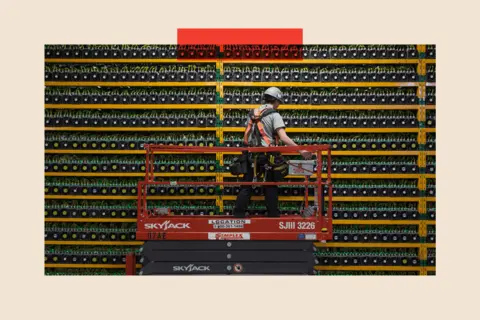
Bitcoin “miners” – who are not actually extracting anything from the earth – verify transactions by solving extremely difficult cryptographic problems that require powerful computers. In return, they are rewarded with Bitcoin.
 LARS HAGBERG/AFP via Getty
As the price of Bitcoin has shot up to its current value of around $100,000 (£75,000), ever-increasing amounts of computing power have been needed to win crypto rewards, shutting out smaller miners in favour of large collectives and companies.
As well as the hum, mining’s energy use has environmental impacts. A Harvard study published in March in the peer-reviewed science journal Nature Communications found that Bitcoin mining exposes millions of Americans to harmful air pollution each year – and that 34 Bitcoin mines consumed a third more electricity than the city of LA. (There was some pushback from the crypto industry to the study, which was called The environmental burden of the United States’ Bitcoin mining boom.)
According to the Cambridge Bitcoin Electricity Consumption Index, mining globally uses approximately 0.7% of global electricity consumption.